
A self improving ai agent is not magic software that wakes up smarter every morning. In business terms, it is an AI system designed to complete work, measure the outcome, store useful context, and improve future performance through feedback loops, memory, evaluations, or controlled updates. That matters because most companies are moving past one-off ChatGPT prompts and toward AI systems that actually touch sales, support, operations, finance, and internal knowledge work.
The opportunity is real, but the hype is sloppy. A self improving ai agent can help a team reduce repetitive work, catch process gaps, and make better decisions over time. It can also create expensive problems if it learns from bad data, takes action without approval, or quietly changes behavior without anyone noticing. Our research shows that the winning businesses are not the ones chasing the most autonomous agent. They are the ones choosing one measurable workflow, putting guardrails around it, and improving the system in controlled stages.
What a Self Improving AI Agent Actually Means
Traditional automation follows fixed rules. If a form is submitted, send an email. If an invoice arrives, add it to accounting software. That is useful, but it does not adapt unless a human changes the rule. A self improving ai agent adds a learning layer around the workflow. It can review what happened, compare the result against a goal, remember useful information, and recommend or apply improvements.
That improvement can happen in several ways. The safest version is human-reviewed improvement, where the agent logs weak outputs, suggests changes, and waits for approval. A more advanced version uses evaluation scores to adjust prompts, routing, retrieval rules, or tool choices. The riskiest version allows the agent to rewrite parts of its own process or take new actions automatically. Most small businesses should start with the first version, not the third.
IBM describes AI agents as systems that can perform tasks by designing workflows with available tools, while agentic AI adds goal-directed planning with limited supervision. MIT Sloan has also emphasized that accountability gets harder when agents perform workflows with little or no human supervision. Those points line up with what matters for operators: autonomy is useful only when responsibility, measurement, and review are clear.
Self Improving AI Agent vs Normal AI Automation
The difference is feedback. Normal AI automation can summarize emails, draft replies, classify leads, or update a CRM. A self improving ai agent asks: did that action produce the intended outcome, and what should change next time?
For example, a standard lead qualification bot might score every inbound form based on company size, budget, and urgency. A self improving version would compare its scores against actual sales outcomes. If it keeps overvaluing small low-intent inquiries, it can flag the pattern and recommend an updated scoring rule. If it keeps missing high-value prospects that use different language, it can update its retrieval examples or ask a manager to approve a new qualification signal.
That does not mean the agent should be free to change everything. In a business environment, improvement should usually be bounded. The agent can learn from completed tasks, but a human should approve changes that affect pricing, legal language, customer commitments, financial decisions, data permissions, or public-facing content.
Where Self Improving AI Agents Fit in a Business
The best first use cases are high-volume, repeatable workflows with clear success signals. If the outcome is vague, the agent cannot improve in a reliable way. If the process is rare, there is not enough feedback. If the work carries high legal or financial risk, the automation needs more controls than most teams are ready to manage on day one.
Good candidates include customer support triage, inbound lead routing, meeting follow-up, proposal drafting, knowledge base maintenance, invoice review, internal help desk requests, recruiting screeners, and content operations. These workflows have enough repetition to learn from patterns, but they can also keep a human checkpoint before the final action.
For broader context on how this fits into operational AI, see our guide to AI workflow automation for business. A self improving agent is not a replacement for workflow strategy. It is a more adaptive layer on top of a workflow that already has a clear owner and business goal.
If you want help identifying the safest workflow to automate first, Apply For A Free AI Agent Audit. We help business owners map practical AI opportunities, choose the right tools, and avoid expensive automation mistakes.
The Business Case: What Should Improve?
The business case should be specific before the agent is built. Vague goals like "make the team more productive" are too broad. Better goals sound like this: reduce average response time for inbound leads, improve support ticket routing accuracy, cut manual invoice review time, increase follow-up completion, or reduce duplicate internal questions.
Each goal needs a baseline. If the sales team currently responds to new leads in six hours, the first target might be under thirty minutes for qualified inquiries. If the support team misroutes 18 percent of tickets, the first target might be under 8 percent after agent-assisted triage. The agent then has a real feedback signal. It can compare performance over time instead of pretending every output is equally useful.
Our research shows that this is where many AI projects fail. Teams buy the tool before defining the workflow metric. Then the agent produces activity, but nobody can prove whether it improved the business. A self improving ai agent should be judged by operational movement, not by how impressive the demo looked.
How the Improvement Loop Works
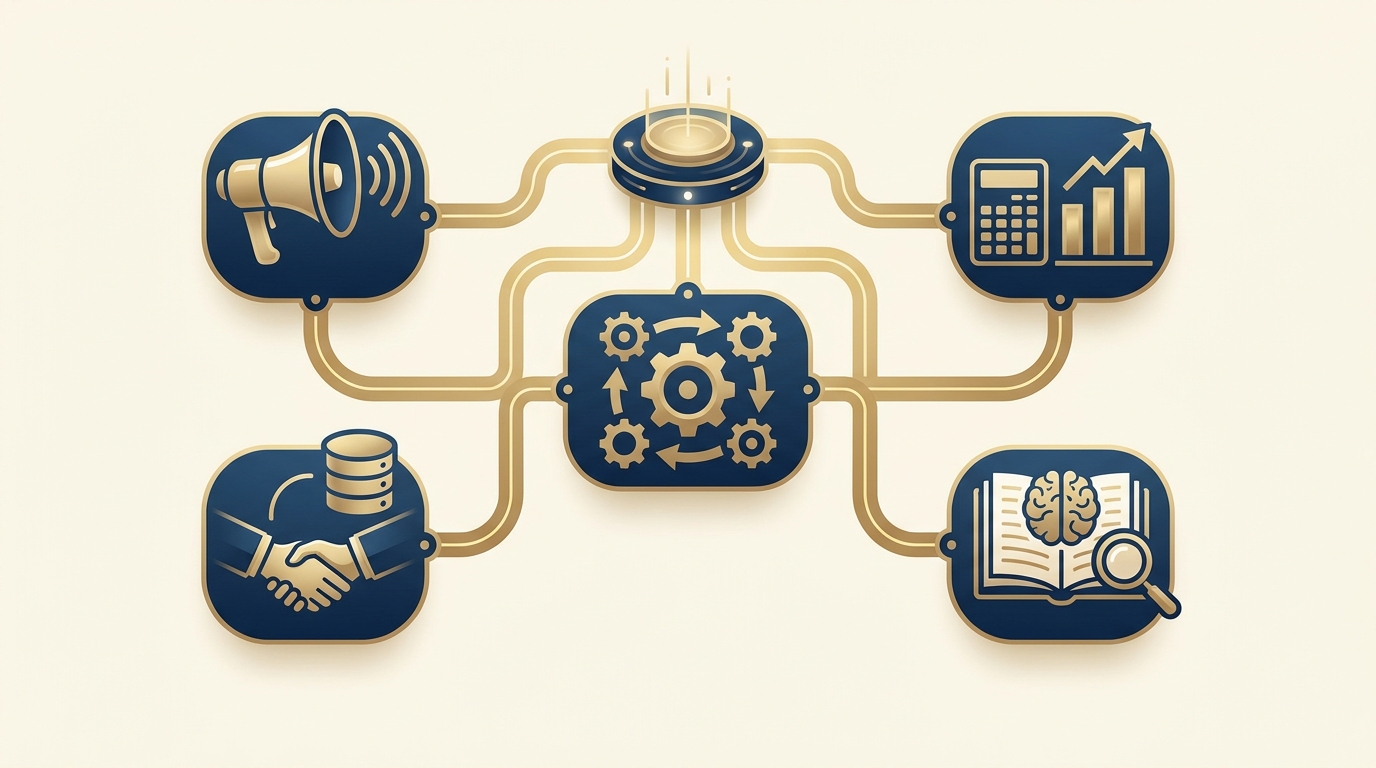
A practical improvement loop has five parts: task execution, outcome capture, review, controlled update, and monitoring. First, the agent performs a defined task such as drafting a customer reply or routing a lead. Second, the system captures what happened next. Did the customer respond? Did the sales rep accept the lead score? Did the invoice get corrected? Third, the agent or a reviewer identifies what should change. Fourth, the improvement is applied inside a controlled boundary. Fifth, performance is monitored to make sure the change did not create a new problem.
This loop can use memory, retrieval, prompt updates, tool selection, ranking models, human feedback, test cases, or structured evaluations. The important part is not the technical label. The important part is that improvement is measured against real work and reviewed before it affects sensitive decisions.
For smaller businesses, the simplest version is often enough. Keep a database of approved examples, rejected outputs, common corrections, customer preferences, and workflow rules. Let the agent reference that knowledge when doing similar work in the future. That gives you practical improvement without turning the system into an uncontrolled experiment.
Risks of Self Improving AI Agents
The biggest risk is quiet drift. If an agent changes behavior over time, a workflow can get worse without anyone noticing. A sales agent might learn to prioritize easy deals instead of profitable deals. A support agent might learn to close tickets quickly instead of solving the issue. A content agent might learn to write for clicks while weakening accuracy. Optimization is only good when the target is correct.
Data quality is another risk. Agents learn from the information they can see. If your CRM is messy, your support tags are inconsistent, or your knowledge base is outdated, the agent may reinforce the wrong patterns. This is why AI readiness matters before automation. Our AI readiness checklist covers the operational basics that should be in place before a company gives AI access to important workflows.
Security and permissions need special attention. Agentic systems can use tools, connect to apps, and take actions. That makes them closer to digital employees than static software. NIST's AI Risk Management Framework emphasizes governance, mapping, measurement, and management of AI risks. For agentic systems, those ideas become practical requirements: least-privilege access, audit logs, human approval gates, rollback plans, and clear accountability.
A Safer Implementation Checklist
Start with one workflow. Pick a process that happens every week, has measurable outcomes, and does not require the agent to make high-risk decisions without review. Define the owner, the success metric, and the approval boundary before any tool is connected.
Next, map the inputs and outputs. What data does the agent need? Which systems can it read? Which systems can it write to? What actions require human approval? What should the agent never do? These boundaries should be written down. If the rules only live in someone's head, the implementation will become fragile fast.
Then build an evaluation set. Save examples of good outputs, bad outputs, edge cases, and unacceptable behavior. Test the agent against those examples before rollout and after every meaningful change. This is the difference between a serious business system and a shiny prototype.
Finally, monitor the agent after launch. Review performance weekly at first. Look for accuracy, speed, user adoption, exceptions, and complaints. If the agent is allowed to improve its prompts, memory, or routing rules, keep a change log. Every improvement should be traceable.
What to Buy vs What to Build
Most small businesses should not start by building a custom self improving agent from scratch. The better path is usually a proven platform or workflow stack with strong integrations, clear permissions, and reporting. Custom work makes sense when the workflow is central to the business, the data is proprietary, or off-the-shelf tools cannot handle the edge cases.
For personal productivity and executive workflows, a lighter agent may be enough. Our guide to the personal AI agent category explains where these systems help and where they still need supervision. For company-level operations, the standard is higher. The agent needs role-based access, durable memory, testing, and documentation.

If you are evaluating vendors, ask direct questions. How does the agent learn? What data is stored? Can improvements be reviewed before deployment? Can behavior be rolled back? Does the system provide audit logs? Can you restrict access by role? How are hallucinations, bad tool calls, and conflicting instructions handled? If the vendor cannot answer those questions clearly, do not put the agent near sensitive workflows.
When a Self Improving AI Agent Is a Bad Idea
A self improving ai agent is a bad fit when the business process is not understood. If humans disagree on what good looks like, the agent will learn confusion. It is also a bad fit when the company has no clean data, no workflow owner, no review capacity, or no tolerance for mistakes.
High-stakes workflows need extra caution. Legal advice, healthcare decisions, lending decisions, employee discipline, tax filings, and anything involving regulated customer data should not be automated casually. AI can assist with research, drafting, intake, and routing, but final responsibility should stay with qualified humans and documented controls.
The same is true for brand voice and public communication. Letting an agent publish, send, or negotiate without review can create reputation risk. A better approach is agent-assisted drafting, human approval, and gradual expansion only after the system proves reliable.
How to Start Without Overbuilding
The first version should be boring on purpose. Choose a workflow such as inbound lead triage. Give the agent access to the form submission, CRM fields, qualification criteria, and approved response templates. Have it classify the lead, draft the next step, and explain its reasoning. A human reviews the recommendation. Over time, the system learns from accepted and rejected classifications.
After a few weeks, you can measure whether response times improved, whether reps trust the scores, and whether better leads are being prioritized. Only then should you consider more autonomy, such as automatically assigning qualified leads or triggering follow-up sequences. The self-improving part should earn trust through measured performance.
This staged rollout is also cheaper. You avoid paying for complex architecture before proving the workflow deserves it. You also avoid the common trap of building an agent that can do ten things poorly instead of one thing reliably.
Bottom Line: Adopt the Loop, Not the Hype
A self improving ai agent can become a serious advantage when it is tied to a real workflow, a clear metric, clean data, and human review. It can help a business move faster because the system gets better at the work it sees repeatedly. But the same learning loop can create risk if the target is wrong, the data is messy, or nobody owns the outcome.
The right question is not "Can we build an autonomous agent?" The right question is "Which workflow should improve every week, and what controls do we need before AI touches it?" Answer that clearly, and self-improving agents become practical. Skip that step, and they become another expensive AI experiment.
Apply For A Free AI Agent Audit if you want a practical roadmap for agentic AI, workflow automation, and safe AI adoption. We will help you identify the highest-value workflow, define the guardrails, and build an implementation plan that makes sense for your business.
Want a practical AI implementation plan?
If you are comparing AI tools, consultants, or automation ideas, book a free strategy call and we will map the highest-leverage workflows for your business.
Book a Free Strategy Call