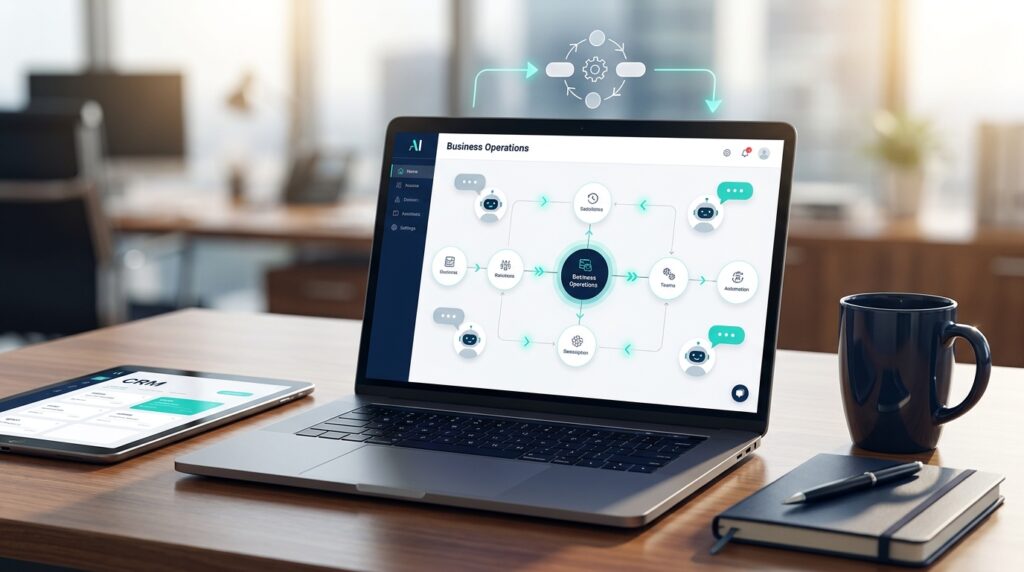
AI workflow automation is one of the most searched operational topics in business right now, but most advice is either too technical or too vague to help an owner make a decision. If you run a small or midsize business, the real question is not whether AI workflow automation sounds impressive. The question is whether it can remove real bottlenecks, cut wasted labor, and improve response time without creating a messy stack of tools your team will avoid.
Our research shows the market has moved past experimentation. Microsoft and LinkedIn reported in the 2024 Work Trend Index that 75% of knowledge workers were already using AI at work, and most users said it helped them save time, focus on higher-value tasks, and work more creatively. McKinsey's 2025 State of AI research also found that organizations are increasingly using AI in revenue, service, and operations functions, with a small group of high performers already reporting meaningful EBIT impact. The data suggests the opportunity is real, but the payoff depends on choosing the right workflows first.
That is where many businesses get it wrong. They buy a tool before they map a process. They automate a broken workflow. Or they chase flashy AI features when the fastest return is sitting inside lead handling, client onboarding, reporting, scheduling, support triage, or internal approvals. AI workflow automation works best when it is practical, narrow, measurable, and tied to a clear business constraint.
What AI workflow automation actually means
AI workflow automation is the use of AI models, rules, integrations, and triggers to move work forward with less manual effort. In plain English, it means setting up systems that can interpret information, generate a useful output, and pass the next step to the right person or platform automatically.
Traditional automation follows fixed rules. For example, when a form is submitted, send an email, create a record, and assign a task. AI workflow automation adds judgment-like capabilities on top of that structure. It can classify inbound messages, summarize calls, draft responses, extract key data from documents, route support tickets by urgency, score leads based on context, and generate first-pass content or analysis before a human reviews it.
That combination is what makes AI workflow automation attractive for small businesses. It does not just reduce clicks. It helps teams handle messy inputs that used to require a person every time. When done well, it shortens the path from incoming information to useful action.
Where AI workflow automation creates the fastest ROI
The best use cases are usually not the most glamorous. They are the workflows that happen frequently, follow a repeatable pattern, and create friction when they stall. If a process runs many times per week and each run requires copying information, reformatting it, chasing approvals, or writing the same message again, it is a strong candidate.
In most service businesses, AI workflow automation produces early wins in five areas:
- Lead intake and qualification: capture inquiries, summarize need, tag urgency, and route the lead to the right pipeline or team member.
- Inbox and support triage: classify incoming messages, suggest replies, and escalate exceptions.
- Client onboarding: turn signed deals into checklists, kickoff emails, document requests, and CRM updates automatically.
- Internal reporting: pull data from multiple tools, summarize trends, and generate weekly operational updates.
- Knowledge work handoffs: summarize transcripts, extract action items, and push them into project tools.
If you are still evaluating whether your business is operationally ready, start with this AI readiness checklist. It will help you separate a good automation candidate from a workflow that still needs cleanup before AI enters the picture.
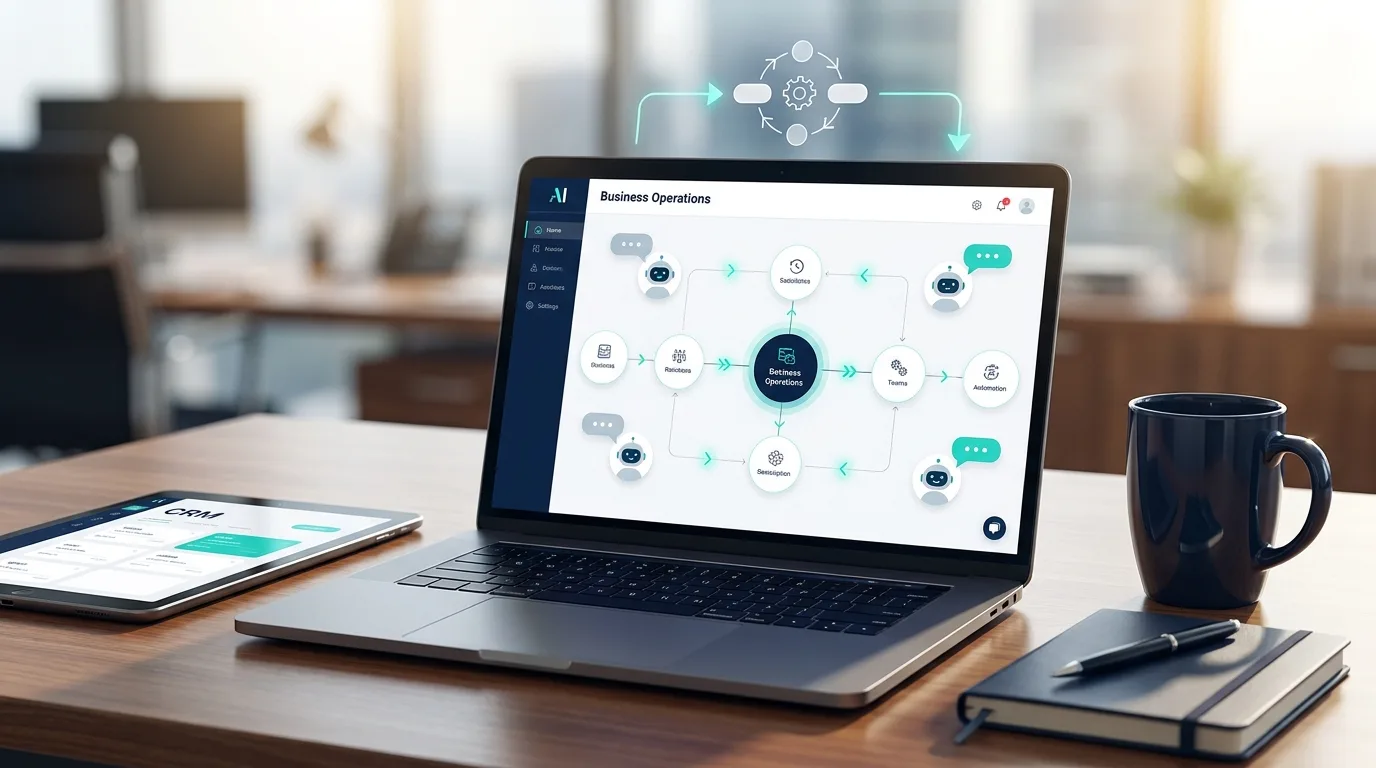
Our research also suggests that employee overload is a major reason these systems matter. Microsoft found that 68% of people say they struggle with the pace and volume of work, and that the average workday is heavily consumed by email, chat, and meetings. AI workflow automation is valuable because it reduces the number of low-value decisions and repetitive handoffs that fill up the day.
Examples of AI workflow automation in real business operations
To make this concrete, imagine a local services business getting website leads, quote requests, voicemail transcriptions, and support questions from multiple channels. Without automation, someone has to read each item, decide what it is, copy data into a CRM, reply manually, assign follow-up, and check whether anything slipped through. That creates lag and inconsistency.
With AI workflow automation, a new submission can be summarized, enriched with service intent, scored for urgency, and pushed into the right pipeline automatically. A quote request can trigger a draft response and internal notification. A support email can be classified by issue type and routed to the correct team. A call transcript can be turned into a task list. The owner or manager still reviews edge cases, but the repetitive sorting work is compressed dramatically.
The same pattern applies to professional services, healthcare-adjacent admin operations, legal intake, real estate teams, and marketing agencies. The common thread is not industry. It is workflow volume plus repetitive context switching.
Need a practical AI workflow automation plan? Aslan Intelligence can map your current process, identify the first workflow worth automating, and design a rollout tied to business outcomes.
How to decide if a workflow is a good automation candidate
Not every process should be automated. A good AI workflow automation candidate usually has four traits:
- High frequency: the task happens often enough that savings add up quickly.
- Clear structure: there is a visible sequence from input to action, even if some judgment is required.
- Meaningful cost of delay: slow execution hurts revenue, responsiveness, or team capacity.
- Reviewable output: a human can quickly approve, correct, or escalate the result when needed.
If a workflow is rare, highly strategic, politically sensitive, or dependent on deep relationship context, AI may help around the edges but should not own the process. On the other hand, if the workflow is repetitive and time-sensitive, AI workflow automation can create fast operational improvement.
Businesses that need help prioritizing these opportunities usually benefit from starting with an implementation plan, not a software shopping spree. That is the same reason many owners first look at how to implement AI in small business before committing budget. Sequence matters. Strategy first, tooling second.
The tool stack behind AI workflow automation
Most AI workflow automation systems are built from four layers. First, there is a trigger source, such as a form submission, new email, CRM update, uploaded document, or recorded call. Second, there is an orchestration layer, often using tools such as Zapier, Make, n8n, or custom integrations. Third, there is an intelligence layer, where an AI model summarizes, classifies, extracts, drafts, or scores. Fourth, there is a destination layer, such as your CRM, help desk, project management tool, spreadsheet, messaging platform, or database.
This matters because business owners often ask which platform is best when the better question is which combination fits the workflow. If you are comparing orchestration tools, our breakdown of Zapier vs Make vs n8n is a useful starting point. The right answer depends on your team's technical comfort, the complexity of your processes, and how much control you need over logic, cost, and maintenance.
Some workflows can be handled with lightweight no-code automation. Others need tighter prompt design, branching logic, error handling, logging, and human review steps. The strongest implementations are rarely the most bloated. They are the ones designed to be stable, measurable, and easy to maintain.
If you want an overview of platform selection before building, see the best AI automation tools for small business. It is a practical way to compare categories before you commit to a stack.
Common mistakes that make AI workflow automation fail
The first mistake is automating before standardizing. If every sales rep handles inquiries differently or every project manager runs onboarding their own way, AI workflow automation will amplify inconsistency instead of fixing it. The process should be documented before it is automated.
The second mistake is expecting full autonomy too early. In most small businesses, the best model is human-in-the-loop. Let AI do the first pass, then let a human approve exceptions and high-risk outputs. This is especially important for customer-facing communication, billing, compliance-sensitive documentation, and anything that affects reputation directly.
The third mistake is measuring success only by time saved. Time matters, but the better KPI set usually includes response speed, error reduction, conversion rate, task completion consistency, and managerial visibility. McKinsey's research has repeatedly pointed to the gap between AI experimentation and value capture. The difference is not who tried AI. It is who built the operating discipline around it.
If you are exploring vendors or outside help, it also helps to understand the market before you buy. This guide to AI automation agencies for small businesses can help you avoid overpaying for vague promises.
What a practical rollout looks like
A practical AI workflow automation rollout usually starts with one workflow, one owner, and one business outcome. For example, you might target lead response time, onboarding lag, or support backlog. Then you map the current state, identify inputs and outputs, define approval checkpoints, and build a narrow first version.
From there, you measure whether the workflow actually improved. Did leads get answered faster. Did admin time drop. Did handoff errors decrease. Did managers gain better visibility. If yes, you harden the workflow with better prompts, edge-case handling, and clearer reporting. Only then do you expand into adjacent processes.
This gradual approach is usually better than trying to build a full operating system all at once. AI workflow automation is powerful, but it still requires governance. Teams need to know what the system does, where human review happens, and how exceptions are handled. Without that clarity, adoption drops and trust erodes.
If you want help identifying the first workflow worth automating, Aslan Intelligence can assess your current operations and map a practical rollout tied to ROI, not hype. The goal is to remove repetitive bottlenecks without creating new operational risk.
Why AI workflow automation matters in 2026
By 2026, the competitive gap is less about whether a business has heard of AI and more about whether it has translated AI into actual operating advantage. The data suggests employees are already using AI informally, often without clear leadership direction. That creates both an opportunity and a risk. Companies that formalize high-value workflows can improve speed and consistency. Companies that let ad hoc tool usage spread without process design can create security, quality, and accountability problems.
AI workflow automation is not a magic layer you pour over a chaotic business. It is a force multiplier for teams that are willing to define how work should move. When the process is clear, AI can compress the manual parts. When the process is unclear, AI just makes the confusion move faster.
The businesses getting real value right now are not the ones chasing the loudest demos. They are the ones using AI workflow automation to reduce handoff friction, tighten execution, and free up human attention for sales, service, strategy, and judgment.
Final takeaway
AI workflow automation is worth serious attention if your business is drowning in repetitive coordination work, slow handoffs, or operational drag. The best place to start is not with the biggest promise. It is with the clearest bottleneck. Pick a workflow that happens often, costs real time, and can be measured. Build a controlled system around it. Then scale from proven results.
Ready to implement AI workflow automation without wasting budget? Contact Aslan Intelligence for a practical rollout plan that prioritizes the right workflow, the right stack, and the right review checkpoints.
Want a practical AI implementation plan?
If you are comparing AI tools, consultants, or automation ideas, book a free strategy call and we will map the highest-leverage workflows for your business.
Book a Free Strategy Call