
If you are evaluating an ai automation agency for small businesses, you are probably asking two practical questions. What exactly will they automate in a company like mine, and will the investment pay for itself quickly enough to matter? Those are the right questions. The data suggests small businesses are moving from AI curiosity to AI operations, but results still depend on scope, execution quality, and how well automation is tied to real bottlenecks.
Our research shows the strongest AI automation projects for small teams focus on repetitive workflows with measurable impact, such as lead follow-up, inbox triage, appointment scheduling, quote generation, invoice reminders, and frontline customer support. Agencies that start with those systems usually produce faster wins than agencies that start with broad strategy decks or generic tool demos.
What an ai automation agency for small businesses actually does
An AI automation agency does more than install software. In a good engagement, the team maps your current workflows, identifies high-friction tasks, redesigns those processes, and builds automation that your staff can actually run. That often includes:
- Workflow mapping across sales, service, and operations
- Tool selection and integration with your existing stack
- AI-assisted process design, including prompts, rules, and human review points
- Automation buildout in platforms like Zapier, Make, HubSpot, or custom scripts
- Testing, QA, and error handling
- Team training and documentation
- Performance tracking tied to KPI targets
Based on Salesforce SMB reporting, many small businesses are investing in AI specifically for customer service, marketing, and sales forecasting. That aligns with what agencies typically implement first, because those functions produce obvious performance data and usually have repeatable tasks that are ready for automation (Salesforce).
If you need a baseline understanding of workflow design before agency engagement, this guide on AI workflow automation is a useful internal reference point.
Where small businesses usually get value first
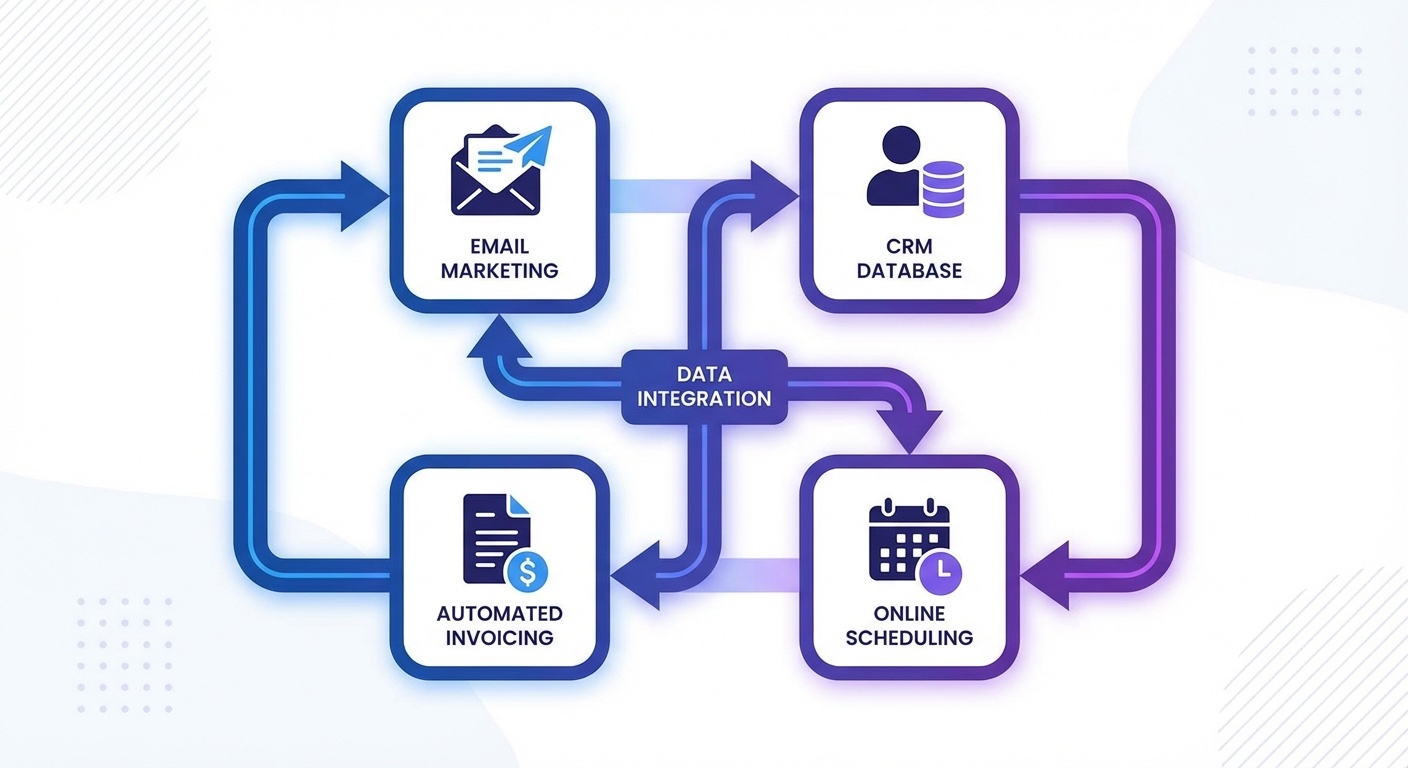
Most businesses with 5 to 50 employees should not begin with complex custom AI models. They should begin with process automation that combines existing tools with lightweight AI actions. The highest-probability use cases include:
Based on our research across public benchmarks and market data from Zapier and HubSpot, these six functions produce the most consistent early results because they have high request volume, low decision complexity, and clear success metrics. They are also the areas where staff time savings are most visible within the first 30 to 60 days of a new automation.
Email and inbox operations
- Auto-categorize inbound messages by topic or urgency
- Draft response suggestions for approval
- Route requests to the right team member with SLA tracking
CRM and lead management
- Auto-enrich new leads from form submissions
- Trigger follow-up tasks and reminders
- Score leads based on fit and behavior signals
Invoicing and payments
- Send invoices automatically when jobs are marked complete
- Issue payment reminders on a defined cadence
- Flag late accounts for escalation
Scheduling and appointment flow
- Automate booking confirmation and reminder sequences
- Collect intake details before appointments
- Reschedule no-shows with minimal manual effort
Social media and content operations
- Convert long-form content into short social drafts
- Queue and schedule post variations by channel
- Track engagement trends and suggest timing adjustments
Customer support and FAQ handling
- Deploy AI chat support for common questions
- Escalate exceptions to humans with context summaries
- Tag support conversations for recurring issue analysis
McKinsey's 2023 state-of-AI reporting shows broad adoption across business functions, with frequent use in service operations and marketing. That macro trend supports a practical takeaway for smaller companies: start in functions where request volume is high and process variation is low (McKinsey).
Want a clear automation roadmap before you hire?
We can map your highest-friction workflows and show exactly where AI can reduce manual work in your business during a free strategy call.
Expected ROI and time savings from an ai automation agency for small businesses
Small business owners should treat AI automation like any other operations investment. You need assumptions, baseline metrics, and a payback model. You do not need perfect forecasting, but you do need disciplined measurement.
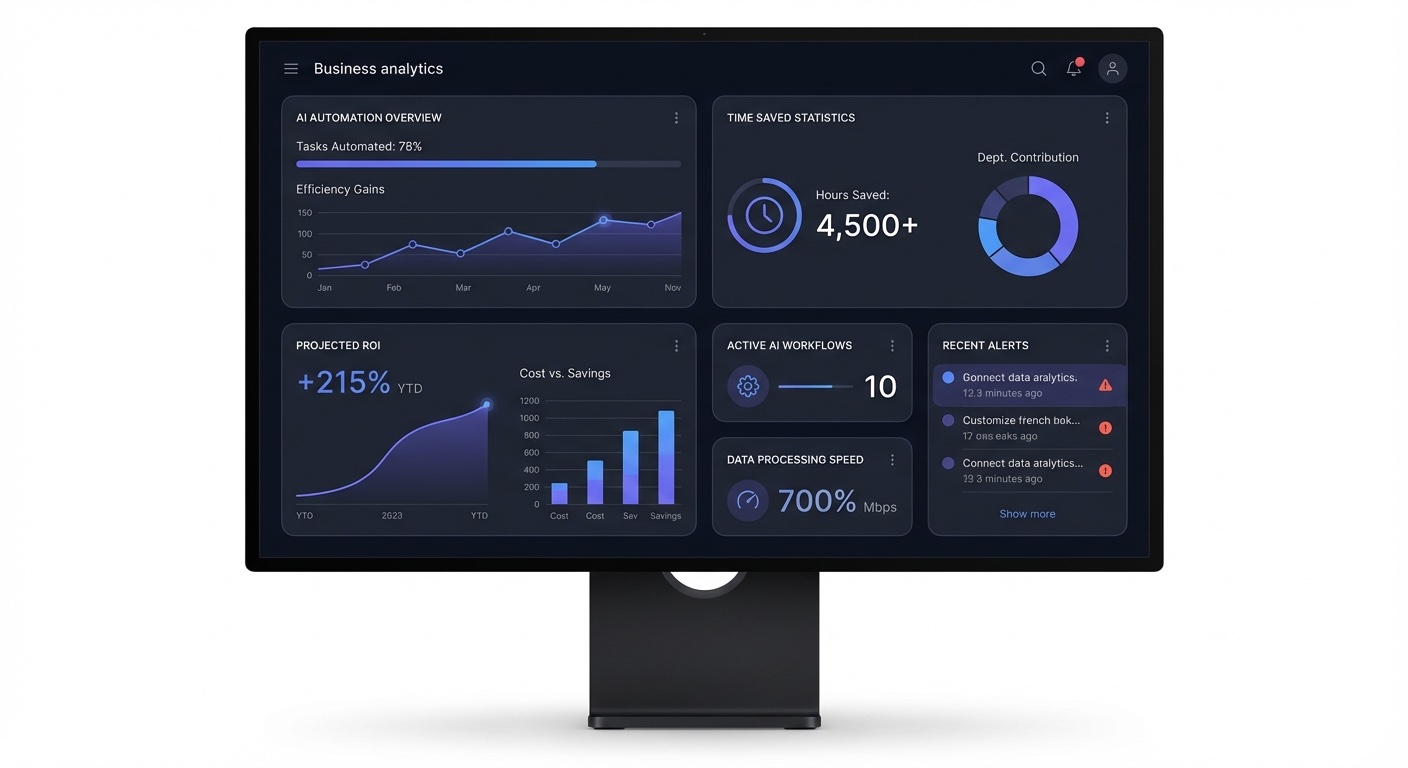
Our research shows time savings are often the first measurable result. Business.com cites data that small business workers save about 5.6 hours per week with AI tools, while other market reports cite broader ranges depending on function and maturity (Business.com). Results vary, but even conservative savings can compound quickly across a team of 10 to 30 people.
For ROI expectations, many public benchmarks are directional rather than apples-to-apples. Some industry reports cite strong return multiples and short payback windows, but these outcomes typically depend on implementation discipline and use-case selection. For example, one frequently cited benchmark puts AI returns at about $3.70 for every $1 invested, and another claims rapid 30-90 day payback in select contexts (Graf Growth Partners, AI Crescent). Use these as directional references, not guaranteed outcomes.
A practical model for small businesses is to target one high-frequency workflow first, then expand after measurable gains. Example:
- Current manual workload: 20 hours/week on lead intake and follow-up
- Post-automation workload: 8 hours/week
- Net savings: 12 hours/week
- At $35/hour blended labor cost: about $1,680 monthly value recovered
If your pilot costs $4,500, simple payback is under three months. If it costs $9,000, payback is roughly five to six months, assuming quality stays consistent and rework remains low.
What agencies charge and how pricing usually works
Pricing can vary widely, so proposals should be compared by deliverables and business outcomes, not by hourly rates alone. Based on Clutch market data, many AI development engagements fall in the $10,000 to $49,999 range, with consultant hourly rates often listed from $25 to $49 in some segments (Clutch). For small companies, initial automation projects are often narrower in scope than full AI product development, so final costs may land below or within the lower end of those ranges depending on complexity.
Our research also found a broad spectrum of freelancer and boutique offerings, including fixed-scope plans and monthly retainers. Upwork listings show entry-level fixed packages in the low hundreds for very specific deliverables, while ongoing implementation support can run from around $1,500 to $7,000+ per month depending on expertise and scope (Upwork).
In practice, most agency pricing models fall into three buckets:
- One-time implementation: Good for a single workflow or tightly defined project
- Monthly retainer: Better for phased automation across multiple departments
- Hybrid model: Upfront build fee plus lower monthly optimization support
Ask every agency to include these items in writing:
- Exact scope and excluded work
- Integrations included and data ownership terms
- Error handling and monitoring responsibilities
- Training and documentation deliverables
- Success metrics and reporting cadence
How to evaluate fit before hiring
Choosing the right AI partner is less about who sounds smartest and more about who can execute safely inside your real operating environment. A credible agency should ask for workflow context, data constraints, and business targets early. If they skip discovery and jump straight to tools, that is a warning sign.
Use this checklist during discovery calls:
- Process-first approach: Do they map your current process before recommending software?
- Measurement discipline: Do they define baseline metrics and target improvements?
- Human-in-the-loop design: Do they include approval checkpoints for high-risk actions?
- Operational handoff: Will your team get documentation and training?
- Maintenance clarity: Who handles failures, API changes, and workflow drift?
If you are still deciding between strategy support and implementation support, review this breakdown of AI consulting for small businesses. Many companies need both, but in different phases.
Common mistakes that reduce returns
Even solid agencies can underperform when project design is weak. The most common issues we see are:
- Trying to automate too many workflows in phase one
- Lack of clean process ownership on the client side
- No baseline data before rollout
- Poor exception handling when AI outputs are uncertain
- Ignoring staff adoption and change management
The data suggests outcomes improve when businesses sequence projects by operational impact, then expand gradually. For example, customer communication and marketing execution are often easier to standardize than bespoke back-office decision workflows. If marketing is a near-term priority, this resource on AI marketing automation can help you compare likely wins before committing budget.
Is hiring an ai automation agency for small businesses worth it?
For many firms in the 5 to 50 employee range, yes, but only if the engagement is scoped correctly. Hiring an agency is often worth it when:
- Your team repeats the same workflows every day
- Manual follow-up causes revenue leakage
- You lack in-house capacity to design and maintain automations
- You can track operational metrics before and after deployment
It may not be worth it yet when processes are still unstable, leadership cannot assign an internal owner, or success metrics are undefined. In those cases, run a process cleanup sprint first, then automate.
Based on current market data from Salesforce and McKinsey, adoption momentum is clear, but success still comes down to execution quality and business alignment, not tool hype. A focused pilot with measurable targets is usually the most reliable way to test value before scaling.
Red flags to watch for during the sales process
Not every agency that claims to specialize in AI automation for small businesses delivers the same quality. Before signing any agreement, watch for these warning signals during the engagement phase.
Vague deliverable definitions. If a proposal lists "AI strategy", "automation buildout", or "workflow optimization" without specifying the exact number of automations, the tools involved, or the acceptance criteria, ask for a revised scope of work before you proceed.
No discovery period. Agencies that skip the intake phase and move straight to demos or tooling recommendations have not actually assessed your business. Good automation design requires understanding your data, your team structure, your current tools, and your compliance constraints.
Ownership ambiguity. Ask directly: who owns the automations after the engagement ends? Some agencies build inside proprietary platforms that require ongoing fees to maintain access. Others build inside your own accounts and hand over full control. These are very different financial commitments.
Overpromised timelines. Complex multi-system automations take time to test properly. If an agency promises a fully operational, integrated automation suite in two weeks with no prior discovery, the timeline is either unrealistic or the scope is much narrower than it sounds.
No references from comparable businesses. Ask for two to three client examples in your size range or industry. Agencies that only reference enterprise case studies may not have experience with the specific constraints and limited IT support that smaller companies operate under.
Taking time to validate these factors upfront usually prevents larger problems at delivery. It also helps you identify agencies that think in terms of outcomes rather than outputs.
Ready to work with an AI automation agency?
If you want practical next steps, we will review your workflows, identify high-ROI opportunities, and outline a realistic implementation plan in a free strategy call.